The Japanese Highball: History, Culture, and Why It Took Over
Walk into any izakaya in Japan and you’ll hear it before you see it: the sharp crack of ice, the hiss of soda water, a glass hitting the counter. Someone just ordered a highball. Probably several someones. In a country with centuries of sake and shochu tradition, a drink made from whisky and carbonated water has become the default order for millions of people. That’s not an accident. It’s the result of one company’s century long effort to make whisky feel Japanese.
The Drink Itself
A Japanese highball is whisky and soda water over ice. That’s it. No garnish required, though a lemon twist is common. The ratio runs roughly 1:3 or 1:4, whisky to soda, depending on the bar and how generous the pour is.
What separates the Japanese highball from a Scotch and soda at an American bar isn’t the recipe. It’s the precision. Bars in Japan treat the highball as a craft, not a throwaway mixed drink. The ice is hand cut or carefully selected for density. The soda is poured gently down a bar spoon to preserve carbonation. The glass is frozen. Suntory’s famous “perfect serve” protocol calls for 13.5 stirs, a number chosen because it chills and integrates the drink without losing bubbles.
Whether 13.5 stirs is tradition or marketing depends on how generous you’re feeling toward Suntory. Either way, the philosophy behind it is real: the highball deserves the same care as any cocktail.
Whisky Comes to Japan
To understand why the highball matters, you need to understand how whisky arrived in Japan and almost disappeared.
Shinjiro Torii built the Yamazaki in 1923, the first commercial whisky distillery in Japan. He’d hired Masataka Taketsuru, a chemist who had studied distilling in Scotland, to run production. Their collaboration produced Japan’s first domestically made whisky, Suntory Shirofuda, in 1929.
Taketsuru left in 1934 to start his own company, which would become Nikka, and built the Yoichi distillery in Hokkaido. Two companies, two visions, one emerging industry. But whisky was still a niche product. Most Japanese drinkers stuck with sake and beer.
The Postwar Boom: Torys Bars and Mizuwari
The real shift came after World War II. In the 1950s, Suntory launched an aggressive strategy to normalize whisky for everyday Japanese consumers. The centerpiece was the Torys bar chain: small, affordable, standardized bars serving Suntory’s Torys whisky (a blend designed for mixing) at prices working people could afford.
Torys bars spread across urban Japan. They weren’t upscale. They weren’t trying to be. The point was to make whisky as accessible as beer, and to position it as something you drank with dinner, not something reserved for special occasions.
During this period, mizuwari (水割り) became the dominant serve. Whisky diluted with roughly 2 to 2.5 parts water, served at room temperature or slightly chilled. Mizuwari made whisky softer, lower in alcohol, and compatible with Japanese food. The “bottle keep” system also took root: regulars would buy a bottle at their favorite bar or izakaya and the staff would store it with their name on it, pulling it out whenever they visited.
By the 1960s, whisky had become embedded in Japanese social life. Salarymen drank Suntory Old at the office party. Suntory Kakubin became the izakaya standard. Domestic whisky production peaked around 1983, with industry volumes hitting roughly 12.4 million cases. (For the full timeline, see our history of Japanese whisky.)
The Crash
Then it fell apart. From the mid 1980s through the 2000s, Japanese whisky consumption plummeted. A younger generation rejected their parents’ drinking habits. Shochu experienced a boom. Wine imports climbed. Beer remained king.
Distilleries shuttered production lines. Suntory and Nikka both scaled back, mothballing stills and reducing stock. The decades of whisky that weren’t produced during this period are the reason aged Japanese whiskies are so scarce (and expensive) today.
By the early 2000s, Japanese whisky looked like a dying category. Domestically, it was seen as an old man’s drink. The few international whisky enthusiasts who knew about it were just starting to pay attention, but the home market was in freefall. (If you’re new to the category, our beginner’s guide to Japanese whisky covers the basics.)
The Highball Revival
This is where the highball comes back in.
Around 2008, Suntory launched what industry observers now call the “highball boom,” a deliberate, company wide campaign to reposition the whisky highball as a young, fresh, food friendly drink. The strategy was multi layered:
Reframe the drink. Suntory promoted the highball not as a cocktail but as a beer alternative. Same price range, same refreshment, same compatibility with food. If you were going to order a draft beer at an izakaya, why not try a highball instead?
Build the infrastructure. Suntory installed dedicated highball taps (essentially soda dispensers paired with whisky) in bars and restaurants across Japan. This standardized the drink: consistent ratios, proper carbonation, cold glass. You didn’t need a skilled bartender. The machine handled it.
Pick the right whisky. Suntory Kakubin, the square bottle blend first released in 1937, was already the standard izakaya whisky. It was designed for mixing. Its flavor profile, light, slightly sweet, with enough grain character to stand up to soda, made it the ideal highball base. Suntory leaned into this hard.
Market to women and younger drinkers. The campaign explicitly targeted demographics that had abandoned whisky. Commercials featured young women ordering highballs at stylish restaurants. The message: this isn’t your dad’s whisky. It’s a refreshing, modern drink that happens to be made from whisky.
It worked. Within a few years, whisky consumption in Japan reversed its decades long decline. The highball became the default order at izakaya across the country, competing directly with beer for the first pour of the evening.
The Izakaya Highball
To understand the highball’s place in Japanese drinking culture, you need to understand the izakaya.
An izakaya is a casual drinking establishment, closer to a pub than a restaurant, where food and drink are ordered together throughout the evening. Groups arrive, order drinks immediately (often before even looking at the food menu), and continue ordering both food and drinks over the course of hours.
The first drink, known as the “toriaezu” (とりあえず, meaning “for now”), is traditionally a beer. “Toriaezu beer” is practically a national phrase. You sit down, you order beer, you figure out the rest later.
The highball has cracked into this ritual. “Toriaezu highball” is now something you hear regularly, especially among younger drinkers. It occupies the same cultural slot: quick, affordable, refreshing, pairs with everything from yakitori to sashimi.
This is no small thing. In a country where drinking customs are deeply social and deeply habitual, shifting the default first order is a generational change. And the highball did it by being genuinely good at the job: it’s lighter than beer, lower in calories, and the whisky flavor complements grilled and savory food without overpowering it.
Canned Highballs: Convenience Store Culture
Walk into any Japanese convenience store (conbini) and you’ll find an entire refrigerator section dedicated to canned alcoholic drinks. Chūhai (shōchū based highballs with fruit flavoring) dominate the space. But tucked in among them, you’ll find Suntory Kakubin Highball Can.
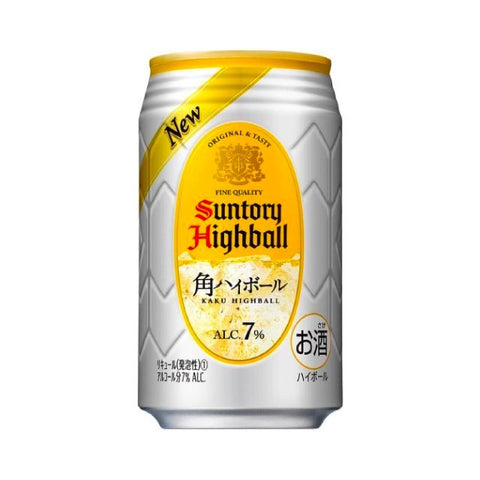
Suntory
Suntory Kakubin Highball Can
Suntory launched its canned highball to capitalize on the on premise revival. The logic was straightforward: if people are ordering highballs at bars, give them a version they can drink at home, at the park, on the train platform after work.
The canned highball category has grown into a significant market. It bridges the gap between the convenience of a ready to drink product and the perception of whisky as something worth choosing over a generic chūhai. In a conbini refrigerator full of fluorescent canned drinks, the gold Kakubin can signals “whisky drinker” in a way that a lemon sour doesn’t.
Other producers have followed. You’ll find canned highballs from various brands, but Suntory’s remains the category leader and the most visible presence in any convenience store.
The Perfect Serve: How Japan Makes a Highball
If you want to make a Japanese highball at home, here’s the method most bars follow:
-
Freeze the glass. A frozen highball glass or tall tumbler. This matters more than you think. A warm glass melts ice and kills carbonation.
-
Fill with ice. Large, dense cubes. Crushed ice melts too fast. Fill the glass completely and stir to chill it, then drain any meltwater.
-
Pour the whisky. One part whisky. For most home serves, that’s about 45ml.
-
Stir briefly. Three or four turns to chill the whisky against the ice.
-
Add soda. Three to four parts well chilled soda water, poured slowly down the inside of the glass or along a bar spoon. The goal is to preserve as much carbonation as possible.
-
Stir gently. One vertical stroke from bottom to top to integrate. Not vigorous. You’re mixing, not aerating.
-
Optional garnish. A lemon twist, expressed over the surface and dropped in. Some purists skip this.
The key principles: everything cold, minimal agitation, maximum carbonation. A flat highball is a failed highball.
Why Kakubin?

Suntory
Suntory Kakubin
Suntory Kakubin deserves special mention because it is, functionally, the highball whisky. Not the best whisky for highballs (we cover that in our highball ranking). The whisky that built the highball as a cultural institution.
Kakubin (“square bottle”) launched in 1937 and became the standard pour at izakaya across Japan. Its tortoiseshell patterned bottle is instantly recognizable. The whisky inside is a blend of malt and grain from Yamazaki, Hakushu, and Chita, designed for mixing rather than sipping. It’s light, slightly sweet, with a clean grain character that opens up beautifully with carbonation.
In Japan, Kakubin is ubiquitous. It sits behind the counter at ramen shops, yakitori joints, family restaurants, and corner izakaya. It’s the Bud Light of Japanese whisky, and I mean that as a compliment: a product so well matched to its purpose that it practically disappears into the occasion.
Outside Japan, Kakubin is harder to find. Suntory Toki was created specifically to fill the Kakubin shaped hole in international markets, serving as the highball whisky for non Japanese audiences.
Beyond Kakubin: The Highball Across Price Points


While Kakubin is the standard, the highball format works across a range of whiskies. This is part of its genius as a cultural vehicle: it scales.
At the entry level, Suntory Toki and The Chita Single Grain both perform well in soda. Toki blends components from Yamazaki, Hakushu, and Chita specifically for this purpose. Chita brings a lighter, sweeter grain character that some drinkers prefer.
Moving up, Hakushu Distiller’s Reserve makes what many consider the finest highball in the Suntory range. Its herbal, minty notes become incredibly refreshing with carbonation, a different experience from the clean, neutral Kakubin style.
Premium highballs featuring Yamazaki 12 or Hakushu 12 appear on menus at upscale bars, though some whisky drinkers feel these are better enjoyed neat or with a splash of water rather than buried in soda. (For neat sipping picks, see our best Japanese whisky to drink neat.)
The point isn’t that every whisky should be a highball. It’s that the highball format created a gateway. People who started with Kakubin highballs at izakaya eventually got curious about what else was behind the bar. The highball didn’t just save Japanese whisky sales. It built a new generation of Japanese whisky drinkers.
The Highball Goes Global
Japan’s highball culture has started spreading internationally, driven by the global boom in Japanese whisky and the broader cocktail renaissance.
Suntory launched Suntory Toki in 2016 primarily as a highball whisky for the US market, priced at the entry level and marketed with the same “highball and food” positioning that worked domestically. Bars and Japanese restaurants outside Japan increasingly feature the drink, and “Japanese highball” appears on cocktail menus from New York to London.
The canned format is following. Japanese canned highballs are appearing in specialty stores and online retailers worldwide, riding the broader ready to drink wave that has swept the industry.
Whether the cultural context translates is another question. The izakaya ritual, the toriaezu order, the social fabric that makes the highball meaningful in Japan, that’s harder to export than the liquid. But the drink itself? A well made whisky highball is one of the most refreshing things you can put in a glass, regardless of which country you’re in.
What the Highball Tells Us
The Japanese highball isn’t just a drink. It’s a case study in how a product category can be revived through cultural repositioning rather than product innovation.
Suntory didn’t invent a new whisky. They didn’t change the recipe. They changed the context. They took an existing product (Suntory Kakubin), an existing serve (whisky and soda), and an existing venue (the izakaya), and they made them fit together in a way that felt fresh, modern, and unmistakably Japanese.
The whisky industry talks a lot about premiumization: pushing consumers toward more expensive, more exclusive bottles. The highball revival did the opposite. It pushed whisky toward everyday accessibility, toward food pairing, toward casual drinking. And in doing so, it created more whisky drinkers than any premium launch ever could.
That’s the real lesson of the Japanese highball. Sometimes the most powerful thing you can do for a product isn’t making it fancier. It’s making it belong. ncier. It’s making it belong.